

The Complete Guide to Recruitment Marketing: Digital Marketing for Recruitment Agencies [20,000 words]
Reviewed by KUNIYUKI IMAMURA (President & CEO, NowVillage Inc.)
Contents
I am Imamura, of NowVillage, which runs a digital marketing company.
I ran a recruitment business for eight years, then a marketing company for four, supporting more than 100 recruitment agencies. Working with a wide range of them, my own and others’, I have written down the marketing theory I have come to recognise in this business.
Who this is for
Anyone about to start a recruitment business and considering which area to work in
Anyone already running one and, as it grows, considering moving into other areas
Summary
Marketing for a recruitment business differs greatly in strategy between experienced candidates (by role, healthcare and childcare, professional services, retail and hospitality, specific skills) and inexperienced ones (graduates and those in their first few years of work) differs greatly in strategy
For experienced candidates, making the case through the vacancy works: scouting services, vacancy banner advertising, landing pages, job and media sites, affiliate advertising and YouTube are the main methods
For inexperienced ones the case is made through advice: affiliate advertising, search advertising, social media (Meta especially), LINE and video content
The key to success is optimising the channel and the message for each segment
Designing the customer success that carries someone from registration to interview, and publishing content that deepens understanding of the employers, also play an important part

To make this guide easier to take in, we have also made it as a video; do watch it when you have time.
Full version
For anyone without time for the full version, there is a short version too.
Short version

1. Segmenting a recruitment business
A recruitment business divides by audience into the following seven layers.
Broadly, those seven fall into two: people with work experience who understand the role they should be doing, the experienced, and those with no experience or very little, the inexperienced. fall broadly into two.

First, the experienced, are as follows.
Role People who look for a new job around their role: I am in sales and thinking of moving, I am a marketer thinking of moving, I am an engineer thinking of moving.
Healthcare and childcare People with a qualification in healthcare or childcare, care workers and nursery teachers, looking for a new post.
(Doctors and nurses we treat as a closed market and leave aside.)
Professional services People with a professional qualification and experience in law or accounting, lawyers, accountants, finance staff, looking to move to a law firm, an accountancy firm or a company.
Retail and hospitality People looking to move to hotels, fashion, homeware brands and other accommodation or shops.
Specific skills People with a particular skill, drivers, site managers, looking for better terms or more rewarding work in the same role.
By contrast, the inexperienced. are as follows.
Graduates People aged 18 to 24 leaving school, college, university or postgraduate study with no work experience, aiming at the April intake.
Early in their working life People aged 18 to 29 who have been working casually since leaving education, or who left a job within three years.
(Incidentally, the author of this article left his first job after nine months and spent about two years working casually.)
2. The difference between experienced and inexperienced candidates: experienced
Before going through each segment, let us explain the fundamental difference in how you make the case to the experienced and the inexperienced. Let us explain the difference in how you make the case to each.

To put the conclusion first,
the experienced, for one it is the vacancy.
the inexperienced. For the other it is advice.
the experienced, People with work experience do not change their role, and can judge which vacancies suit them. Because the role is settled, the marketing methods for them follow naturally.
2.1 Scouting
The scouting services offered by Recruit, Mynavi and BizReach.
These work best of all. Before building your own site, running advertising or working on social media, start here.
The set-up fees are tiny against the revenue from a single placement, and because the fee is paid on results the economics are stable.
There are also companies that supply vacancy databases, so vacancies are rarely a problem.
Broadly, new registrants on each scouting site have the strongest intent to move, so log in regularly and write messages that can be sent to 50 to 100 people at a time.
Write them on the basis of: people of this age with this background have this problem, so emphasise this part of this vacancy.
Write them on that basis.
Rather than thousands of words, keep it short: an opening line such as why not use your experience in consumer sales to step up to business sales, where the relationships are longer and the sums larger, followed by the vacancy’s appeal in bullet points.

The above sets out what they are like. Besides the set-up cost and how they charge, the approval process matters. A large wave in the recruitment market,
employers scouting directly rather than through agencies,
has made the platforms stricter in approving new agency users (some are closed to new users entirely).
Scouting is indispensable for experienced hires, so where the database contains the candidates you want, sign with as many scouting services as you can. Scouting services generally renew a contract as long as it has not produced zero results in six months, so having one in place is useful as a backup should a service suddenly restrict you, or suddenly stop working.

As a record for managing scouting, by target audience track
messages sent
applications
application rate
and in reading them, consider
the time (day of the week and hour)
the audience (how broadly you grouped them)
the wording
the vacancies attached
and run the improvement cycle on those four.
Related article:
Scouting automation that maximises replies
2.2 Vacancy banners and briefings on Meta
A way of attracting candidates using the best-known employers in each segment.
For example:

Sales: Recruit, BizReach, Sansan
Marketing: Money Forward, Hakuhodo
Engineers: Microsoft, Oracle, freee
Lawyers: Anderson Mori & Tomotsune, Nishimura & Asahi
Accountants: Ernst & Young, KPMG
Hokkaido (where the segment is regional): Hokkaido Electric Power, Megmilk Snow Brand
Ask the HR teams at well-known companies for permission to use them in Meta banners. Using a logo is a high bar, but naming the company is often acceptable. Banners along the lines below, emphasising deep connections in the industry or a higher salary, work well.

Related article:
Audience settings for Facebook advertising that deliver, explained in full
2.3 Landing pages for experienced hires
The structure we recommend for a landing page in experienced recruitment is as follows.

The form
Place it within the main visual or immediately below it.
B2B landing pages often put the form at the foot, but on a page aimed at winning candidates through advertising, the form must be near the top.
Logos
Show the logos of the better-known companies among those you place people with. We recommend ten or more. Even where there are few, simply floating them improves how it looks.
Actual vacancies
Show some of the vacancies. If you specialise in manufacturing, show manufacturing roles; if in care work, care roles. The point is to show that you specialise.
Placements
Show a stock photograph, initials, the role before and after, and the salary before and after. Use the kind of example that fits the persona: a man of 26 moving from a retail role on 3.6 million yen to business sales on 4.3 million.
Why people choose you
Show figures such as 80% of applications passing the paper stage, under 2% leaving within a year, second place in an agency ranking. Other options are below.
Common claims
1,200 people supported a year
2,000 vacancies held
15 years of experience
90% receiving an offer
95% customer satisfaction
Experienced career advisers
Where you have advisers with deep industry experience, show their backgrounds; where you do not, show a message of encouragement that conveys your sincerity towards candidates.
For example, emphasising depth of industry experience
Your adviser has three years’ experience in inside sales in the SaaS industry.
Thirteen years in recruitment specialising in lawyers. More than 200 people placed.
Incidentally, while higher earners need a long landing page, for administrative roles, drivers and retail and service work a short page with only the main visual and the form works better than a long one, because users do not read a long page. Produce with the amount of information each audience needs, no more and no less.
Related article:
Measuring form drop-off to improve the number and quality of leads
2.4 Affiliate advertising
This means appearing on ranking sites. Where five or more ranking sites exist in your field, affiliate advertising is worth considering seriously.

Whether they heard the name through scouting or a referral, a candidate searches for the service by name. Appearing across several media then reassures them. And as the next step after scouting we recommend it first, because payment falls at the point of a result, a registration or an interview.
2.5 Job sites and media sites
These strengthen organic traffic, that is, SEO.

Job sites
Candidates register in the expectation that the site handles many roles of the kind they are interested in, and that they will find one that suits them.
In other words, in experienced recruitment a job site is in principle necessary.
But outside a niche, the job sites of Recruit and Mynavi will of course rank first, and a small agency cannot beat them. They dominate the popular fields because of the sheer number of vacancies and the weight of their advertising.
Where your field is niche, a job site focused on one region such as Hokkaido, one role such as security work, or one age group such as school leavers, you should build a job site; otherwise, hold off.
Media sites
Where strong competing job sites with established domain authority already line up in your field, consider building a media site instead. Rather than a site listing many vacancies, write researched and interview-based articles about particular well-known employers.
Keywords to aim at
Company name plus culture, benefits, salary, holidays, history, company profile
For example
If you specialise in placing people in mergers and acquisitions, one well-known employer is M&A Capital Partners.
M&A Capital Partners salary is a term candidates search for, with 1,600 searches a month.
(as of June 2024)
It is recruitment agencies’ articles, not review sites such as OpenWork, that rank highest, and they lead readers to their own services within the article.
(Do search for it yourself and see.)
For sales roles, Recruit holidays; for advertising and marketing, Dentsu culture: terms of that kind are candidates for what to aim at.
Another way of looking at it is to aim at ranking for a term such as best agency for X, or at least at having people reach that article in the end. The ultimate goal of SEO in recruitment comes down to whether you can take a term such as best agency for sales roles.
Is a media site necessary?
Sooner or later, we believe so. In our experience, attracting experienced candidates through a single landing page is hard. You can of course write that you hold unlisted vacancies, that scouting messages will come, that the roles are all above eight million yen, but securing the volume of registrations is difficult and the cost per acquisition does not easily fall.
Related article:
・ The cost of building a job site, and eleven things that make it work
・ A winning strategy and method in content marketing
2.6 YouTube
Where you take the SEO route of building a media site and aiming at terms such as company name plus salary, we recommend producing YouTube video alongside it.

As above, having guests appear and covering the latest developments and the real voices of people who have joined is the kind of content users expect on social media and video. And by
1. embedding the YouTube video in the media site
2. putting the article URL in the video description
you should build the design through to people moving between the media site and the video. a design that moves people between the two.
As an aside, the principles are that
an SEO media site suits making the case on fact (history, company profile)
while YouTube suits making the case on atmosphere (the character of the people working there, what the work involves, anything with a lot of information)
are the principles.
Our agency understands employers deeply, so why not have a free conversation about moving?
is the thinking behind the content, so we hope the above helps with how to express it and which channel to use.
Questions I am often asked, and my answers
Q: I want to attract people in their late twenties to early thirties with three to five years’ experience.
A: That is hard. As you will know, three groups are in demand in the job market.
First: people in their late twenties to early thirties, young, with a certain amount of experience and not yet on a high salary, whom companies value most.
Second: professionals over 35 with real expertise. People with skills and experience in accounting, law, development, design, sales, marketing, networks or listings, who are always in demand.
Third: graduates. Because everyone joins at the same time, planning is easier, and they bring fresh air into the organisation each spring. Your question concerns the first group, and it is hard.
They are the people the large agencies, Recruit, Mynavi, JAC, are winning, so give up on attracting them efficiently at the launch stage.
3. The difference between experienced and inexperienced candidates: inexperienced
Here is what to watch in marketing to inexperienced candidates.

As the material above shows, with graduates the three axes are preparation, advice and peers; understand that the world you are presenting is positive, rather like levelling up in a role-playing game and beating the boss. With those early in their working life, understand that the world is one of gently reassuring people who feel some sense of inferiority.
On that basis, the actual channels are as follows.

First, with inexperienced candidates, graduates and those early in their working life, making the case through the vacancy, which is standard for experienced ones, does not work. Having no work experience, they cannot tell which role suits them.
On that basis, let us go through each channel.
3.1 Affiliate advertising
Searching for best for job hunting, or best agency for people early in their career, brings up many ranking sites. Results for an agency’s name plus reviews are affiliate sites too.
Because so many inexperienced candidates search in this way, affiliate advertising is a principal channel.
And unlike search and Meta advertising below, the volume is steady (which also means it is hard to reduce when you want to), so it is the channel to secure first.

Affiliate advertising never works if you leave it entirely to the provider.
Search yourself and list which sites you want to appear on. At the start your standing with providers and publishers is low, so negotiate a rate around 1.2 times, and set a generous approval rate. Providing company material and banners, and building a landing page that converts above 5% (in affiliate terms, not search), also matters.
At first your negotiating position is weak and the rate tends to be high, but as you build a record some will move the point of approval from registration to the interview.
Run properly it brings candidates cheaply and steadily, so it is worth concentrating on.
Related article:
The effect of affiliate advertising, and how to go about it
3.2 Search advertising
Advertising shown in the results on Google, Yahoo and Microsoft Bing.
Because it is shown to people searching for graduate job hunting or changing jobs early in your career, intent is higher than on other channels. Higher intent means a higher interview rate, the proportion who go on to meet a career adviser after signing up.
From the marketing side, this channel should be judged on the number of interviews and the cost per interview (not on registrations or cost per registration).
Search advertising often costs more per registration but performs well on cost per interview.
Seen from the management side too, search advertising is often superior on both support costs and cost per placement.
Support costs: the staff cost of using email, telephone, SMS and LINE to get a registrant to an interview
Cost per placement: the advertising spend that ultimately went into placing one candidate
On support costs, channels such as Indeed and TikTok that bring registrations but convert to interviews at only 20% carry a hidden indirect cost that should not be dismissed.
On cost per placement, compared with affiliate advertising and candidate referral services, fewer people register with several agencies at once, so competition is lower and the rate at which interviews become placements, the measure by which a career adviser’s work is judged, is higher than on other channels.

As know-how, use automated bidding with broad match as the basis. Performance Max has also worked better since the start of 2024, so where the monthly budget is above a million yen, run it alongside. Beyond enhanced conversions, we also recommend testing optimisation against offline conversions such as interviews booked and interviews held.
Related article:
・ Advertising strategy in recruitment: the kinds of web advertising, their priority, and the points that matter
・ Search advertising in recruitment: going rates and keywords, with examples
3.3 Meta and TikTok advertising
Delivering still images and short video to Instagram and TikTok. For inexperienced candidates, still images work when they speak to the worry, not to the vacancy.
Short video works when it is upbeat: I was worried, but I asked for help and it worked out. One thing to watch with Meta and TikTok is that the landing page receiving the traffic should be a long one.
Unlike affiliate and search advertising, these users are watching while doing something else, so the page has to do the nurturing.
Design and run it as a flow: a screenshot of a LINE exchange with a senior colleague or friend, then here is the agency we recommend, then there is educational content too.
3.4 SEO / SNS / YouTube
As lasting assets you need SEO, social media and YouTube.
But SEO in the graduate and early-career fields is already mature, and taking the main keywords as a new entrant is difficult.
On social media we recommend X over Instagram, as it spreads further.
Because the audience spends a great deal of time on X, awareness builds well.
On YouTube, as with experienced candidates above, publish what SEO cannot express: guest appearances, interview preparation.
SEO calls for fact, so what users want there is how to write a CV, the etiquette of withdrawing from a selection, how an industry is changing.
4. Marketing for experienced candidates by role
In marketing to experienced candidates by role, you first have to divide by role: sales, marketers, engineers.
In attracting them you then segment further within that role.
As examples, here are the lines of argument the author has designed.

4.1 Examples for sales roles
1. An agency specialising in IT companies: ITSales.jp
Sales roles at IT companies, systems integrators above all, pay well and demand will keep growing.
Fees are correspondingly high, so we judge it a good angle.
2. An agency for roles above five million yen: Wakate500.jp
Aimed at people in their late twenties. Above five million yen speaks mainly to those on 3.5 to 4.5 million with five to ten years’ service. The salary is the message, put simply.
3. An agency specialising in business sales: B2BSales.jp
Similar to the first, but business sales pays better than consumer sales. It is aimed at attracting people with consumer sales experience who want to move up.
4.2 Examples for marketing roles
1. An agency specialising in in-house marketing: JishaMarke.jp
Aimed at people who have built marketing experience at an agency or a consultancy.
Agency work centres on supporting other companies, and after a time some want to work on the marketing of one service of their own.
It is about giving them a picture of companies with strong products of their own, such as Sansan and Mercari.
2. An agency specialising in advertising agencies: AgencyTenshoku.jp
The reverse of the first. Marketers at small companies have limited budgets and so limited options. It speaks to those who have tired of routine work and want to move to an agency or a marketing consultancy supporting several companies.
3. An agency specialising in SaaS: SaaSMarketer.jp
A sharper version of the first. Focusing on SaaS, a popular field among marketers, makes the message simple for candidates.
4.3 Examples for engineers
1. An agency specialising in in-house development: MyProduct.jp
In engineering, in-house development, contract work and contracted staffing are all mixed together, and even when a scouting message arrives the candidate has to judge which it is. What engineers want most is experience building a growing product of their own company.
Lining up in-house development roles leads to winning good engineers.
2. An agency for raising your monthly pay by 200,000 yen in contracted staffing: 20UP.jp
Contracted staffing has layers of intermediaries, and depending on the structure the same workplace and the same work can bring the company a different sum, and the engineer a different salary. It speaks to mid-career engineers performing well who want more pay without leaving that model.
3. An agency for engineers from overseas: URPlace.jp
A service for engineers from overseas. UR is short for Your (which is beside the point).
Running a multilingual job site listing only companies able to take engineers from overseas leads to winning good ones.
4.4 The conclusion on marketing by role
1. Decide the line of argument
2. Combine the methods
Build the strategy in that order.
Deciding the line of argument means settling the role as above, then dividing by salary or by the kind of employer.
Then, in combining the methods, set yourself apart by assembling scouting, placing good vacancies on your behalf, a job site, and SEO and social media.
5. Marketing for experienced candidates in healthcare, welfare and childcare
On attracting care workers, physiotherapists and nursery teachers, the allied health field. The key point in designing it is that these people hold a qualification and can work anywhere. Put another way, the terms on offer differ little between vacancies.
So the following matter.

1. An interface that makes searching by location easy
Because people tend to choose the area they want to live and work in, emphasising location is essential in designing the job site.
2. Showing the training, the staff and the physical surroundings
Because the terms differ little, what matters is what training the next workplace offers and what technical and professional experience can be gained there, what sort of people work there, and whether the building inside and out is what the candidate hopes for.
As the author, the ways I would recommend making the case are these.
A:For training and career paths, link to an article the director has written, or have a writer on the job site interview them and set out the merits objectively from their own viewpoint.
is the better choice.
B:For what sort of people work there, a video of the staff is better than a video of the director.
Turnover in this field is high, so conveying who you will work alongside, rather than who leads, is more useful. We recommend real interview videos of the kind below.
(For reference) a real interview video
https://reclive.jp/p/124/302
C:Show the building inside and out in photographs and video. Doing the same work, most people would rather be somewhere bright and clean than dark and dirty.
<A note
This is something most agencies working in this field do not manage to do fully.
It takes a relationship with the practices you place people with, and effort to gather the information.
But doing all of this meets what candidates actually want, so we recommend preparing it steadily.
6. Marketing for experienced candidates in professional services
On marketing to lawyers, accountants, tax advisers and senior finance people such as chief financial officers and heads of administration.
With this audience the case is made on the employer’s brand, the salary and the number of staff.
Building a job site and listing the employers is of course part of it.
But beyond that, applications gather above all around the best-known firms.

Among lawyers, for example, there are the four largest firms:
Anderson Mori & Tomotsune
Nagashima Ohno & Tsunematsu
Nishimura & Asahi
Mori Hamada & Matsumoto
In law, roles at these firms have the strengths of
very good terms
a mark of distinction for the many who think of going independent later
and work on large corporate matters such as strategic legal work, which smaller firms cannot offer
and so attract candidates powerfully.
We therefore recommend two things in how you publish.
1. Make the detail of those brand-name vacancies richer than the rest
Specifically, cover the partners, the staff, the matters handled, the growth of the business, the appraisal system and a day in the life, using photographs, video and illustrated diagrams.
2. Hold online briefings for the firms with the strongest brands, with the agency bearing the cost of attracting people
That is what can be expressed within a job site; to reach practising professionals on YouTube, prepare content such as what is it like to join one of the four largest firms.
Content focused on those four leads to results far more than lining up general pieces on the best way for a lawyer to change jobs.

7. Marketing for experienced candidates in retail and hospitality
On marketing to hotel staff and shop staff in fashion.
With this audience you make the case through the vacancies everyone interested in the industry admires.

Unlike other work, these people have been moved by receiving the service themselves as a customer. So, more than in other fields, the pull of an admired employer has a large effect on registrations.
In the hotel industry, for example, the admired employers would be
The Ritz-Carlton Tokyo
The Peninsula Tokyo
Halekulani Okinawa
are covered.
You approach the HR teams at those employers about working together and advertise their vacancies on their behalf, Indeed included. Ideally you get inside their recruitment work through recruitment process outsourcing. When building your own job site, searching by area matters, but set up a special page such as featured vacancies and place it near the top.
And as with professional services above, give the pages for admired employers more information than the rest.
Alongside the role itself, show the staff’s voices, a day in the life, the benefits, the training, a message from the manager and messages of thanks from guests, with photographs and video.
8. Marketing for experienced candidates with specific skills
On marketing to delivery and taxi drivers and site managers.
Unlike the other segments, this is a market with no overwhelmingly well-known employer.

Area and salary are the first things people search on, but particular to these roles are
flexibility in working hours
some roles offer a three-day weekend; some are fixed-term factory contracts, and so on
benefits
some roles come with accommodation, and so on
incentives
depending on deliveries completed, 600,000 yen a month is not out of reach
training
full training in driving or in construction technique
So a job site is essential, and the above is what should go at the top and in the sidebar.
Marketing by area still applies, so when you win a good vacancy in an area, we recommend producing a banner and running it on Meta.
A small point: the landing page should be short, at the extreme nothing but the main visual and the form. Short pages work better for drivers, nursery teachers and care workers. Put plainly, pages aimed at manual roles and at lower to middle earners do not get read closely. It is the opposite of a B2B service page, where you give plenty of content: an overview, results, white papers.
9. Marketing for inexperienced candidates early in their working life
Attracting young people: those who left education without a job, those working casually, and those within a few years of starting work.
When the author founded an agency specialising in this field in 2012, few companies would take such candidates and the fees were very low, so it drew little attention; with the recent shortage of young people, the number of agencies has grown rapidly.

The concrete methods are set out above under the difference between experienced and inexperienced candidates. The four main methods are affiliate advertising, search advertising, Meta advertising and scouting, with SEO media, Twitter, TikTok and YouTube as the further steps.
In this field around 10% of interviews end in a placement, and career advisers can be brought up to producing results in a shorter time than elsewhere, within six months at most, so a great many new entrants appear.
That is, taking on the field with only the main strategies, affiliate, search, Meta and scouting, means a fiercely contested market in which competitors multiply so fast that you are constantly under pressure.
Get the advertising and scouting up and running quickly, then invest in the awareness channels: X, TikTok and YouTube.
SEO is harder here than in other fields, because giants led by Mynavi and Leverages put budget into it and a late entrant cannot win.
Aim at the approach of investing in an emerging social channel with foresight, as TikTok was just before it took off, building awareness there, and then winning the registration when they see you again on an affiliate site.
10. Marketing for graduates
The keywords in graduate marketing are preparation, meeting people, advice and word of mouth.
Graduates and those early in their working life are both young, but what they want differs entirely.

Specifically, there are four points.
1. Everyone joins in April, and students prepare from their third year at university. Because preparing is understood across society as the thing to do, design content about preparation.
2. They are very positive about job hunting, gather information from their peers, and want to find a good employer together. They are open to meeting people and keen to belong to a community. Create events where people meet: joint briefings, seminars on group discussions, a society for those aiming at trading companies.
3. It is widely understood that it starts with self-analysis, and there is a strong wish to receive advice from seniors and from agencies. On a landing page, emphasise careful counselling rather than the number of vacancies.
4. They are at university every day, with communities in clubs and societies, so word of mouth works powerfully. That is the opposite of the experienced market, where people feel they should hide that they are looking. Rather than checking the result of each channel alone, think about what makes word of mouth happen.
Because of all this, the marketing differs greatly from the experienced market.
Namely, offline marketing matters more than digital. is the point.
Specifically
a joint briefing with 50 companies draws the most people, whatever else you do
the cost of attracting people to job-hunting schools and industry seminars is low
speaking at a careers seminar run by a university yields a large number of contacts in a day
connections with club coaches and seminar professors reach the students who do not attend outside events
and physically opening a job-hunting cafe near a university brings in the students of that area
and so on.
From a business point of view, graduate recruitment differs from the experienced market in that
revenue is only confirmed when the person joins, so cash flow is poor
and the period until they join is so long that 15 to 20% decline the offer (a provision is needed in the management accounts)
experienced candidates go through only three to five selections on average, while graduates go through about fifteen, which makes the placement rate hard to read
and because the users change every year, there is no concept of a customer database
are the disadvantages.
Put the other way, it also means that once you succeed, the barrier to entry is high.
A network that can build offline marketing, or that looks able to
and the funds to withstand the cash flow
If you have those two, you have the conditions to compete in this market.
11. The customer success that carries someone from registration to an interview
Registration: obtaining the person’s details
Interview: the career adviser holding the conversation about work
are our definitions.
A marketing channel is ultimately judged on cost per placement..
But because the period to a placement is long, in the short term it is usually judged on cost per interview.
It is never cost per registration.
The reason is that channels such as Indeed and TikTok bring a low cost per registration but a low rate of moving from registration to interview (that is, many casual users), so judging on cost per registration does not capture the true value.
Breaking the process from registration to interview down gives the following.
Registration (response) – interview booked – interview held
So to keep the cost per interview down you must improve three things:
lower the cost per registration
raise the proportion of registrations that become booked interviews
raise the proportion of booked interviews that actually happen
— those three factors need improving.
We define the second multiplied by the third as the interview rate.
Target interview rates are 50% for scouting, 35% for advertising and 25% for Indeed.
Here we set out the process and the concrete steps for raising that interview rate.
There are three main points.

11.1 Structure
There are four steps from registration to the interview.
Here is what to watch at each.
This concerns traffic from advertising. Scouting and Indeed are applications to a vacancy, so the following does not apply.

Step 1: the landing page

Put the registration form near the top so people can sign up without difficulty.
Place three calls to action within the page (buttons reading something like talk to us about moving), and a sticky one that stays at the foot of the page.
You may think
this is about conversion, not customer support,
but many companies set the conversion as adding a LINE account rather than completing a form. LINE gives a lower cost per registration, but given the lower interview rate, the know-how and staff cost of chasing people to an interview, and the absence of a point of approval for affiliates, we recommend the form over LINE. That is why it is covered here.
Step 2: the form
The forms we recommend are these.

1. A step form that shows how far through you are as each field is completed.
2. A chat-style form that asks one question at a time.
We recommend one or the other,
because the completion rate is higher than on an ordinary form.
Keep the number of questions as low as you can.
(This can bring you into conflict with the career advisers, but maximising interviews comes first.)
A small point: make the first question a light one that is easy to answer, such as the role they have worked in or their year of graduation, and put the written fields, name, email address, telephone number, towards the end.
There is also the pattern of asking for a preferred interview date as the last question in the form, and we have seen that raise the interview rate to 70%.
(Search and Meta advertising aim strongly at maximising registrations, so it suits them less well; affiliate advertising charges on registration, so raising the bar by asking for a date and holding out for better-quality users is reasonable.) Using different pages for different channels is a valid approach.

Step 3: the thank-you page
Once the details are entered and the person presses the button to register or to request a conversation, the thank-you page appears.
Set that page as the point of conversion in GA4, Google Ads, Meta and affiliate advertising.
Here is an example of a thank-you page.

There is also the pattern of arranging the date within the thank-you page using a tool such as eeasy or TimeRex.

Many agencies try to fix the date by LINE or telephone after the form is submitted.
But
people registered while at work, so calls do not connect
with LINE you cannot chase someone until they have sent you a message first
and replies come by SMS or LINE in the evening or at the weekend, so the support team’s reply is delayed and the booking is slow to firm up
all occur. Fix the date and time at registration, when the person is warmest.
Cancellations after booking also run at 30% in recruitment (so the proportion of bookings that happen settles at around 70%).
To reduce cancellations even a little, add a cancellation policy and a tick box as a check.
Step 4: tools for following up
Even with the date fixed on the thank-you page, cancellations and no-shows happen.
After registration, use the tools below to stay in touch, secure the booking and prevent cancellation.
There are four such tools, in the following order of priority.

The order means that using them in this sequence is most effective.
First: the telephone
Call first. Ideally within ten minutes of registration, and at the latest within one working day. We recommend Sokucom from Foonz. It is an auto-dialler: as soon as someone registers it calls them, and when they answer the call is transferred to you.
In another industry it is much like Hikkoshi-zamurai; candidates often register with several services at once, so the speed of the call matters greatly. Leave the speed to a system.

Second: LINE
After the interview is booked, show a LINE QR code and continue the conversation there.
Replies come more readily on LINE than by telephone, year on year.
For candidates who have dropped out at each stage, use it to arrange dates, present vacancies and send articles.

For those who registered but cannot be reached by telephone, set the message and the menu as follows.

You can also present vacancies as cards by audience and aim at an acceptance.

We recommend the LINE extension app Little Help Connect (https://www.littlehelp.co.jp/), because it can merge the data in your CRM with the LINE registration.

Without that merge, the personal details in the CRM (say, Mr Takashi Matsumoto) and those on LINE (say, Taka.M) do not match, and you cannot revive dormant candidates.
The experience we ultimately want is this:
each time a recruiting adviser wins a vacancy, the right candidates hear about it by LINE, email or telephone within one working day.
are our definitions.
Little Help Connect does require a marketing automation platform such as HubSpot behind it, but with that you can build the marketing system you want.

Third and fourth: SMS and email
For those who do not respond to a call or to LINE, approach them by SMS push notification and by email.
11.6 Resource
Check your resource too.

Weekday evenings and weekends, in the figure above, are easily neglected.
The attitude is that registrations in the evening or at the weekend can be called the next morning or on Monday.
Except for those working casually, most people sign up about work in the evening or at the weekend.
And it is during a long break that people stop and wonder whether to carry on as they are.
So place people, part-time staff will do, on the second and third of those.
A small point: permanent staff work weekdays with weekends off, and you cannot leave one part-time person alone in the office, so have them work remotely.
11.6 The leader
Compared with recruiting advisers and career advisers, customer support is seen as a back-office function and is staffed by people with strong hospitality. There is nothing wrong with that, but it is a very important unit, and the leader should have the following abilities and character.

1. Writing a weekly report with analysis and presenting it to management
Specifically, reporting the number of interviews booked.
Marketing and support are two teams that together bear responsibility for supplying the career advisers with a monthly number of interviews. The number of interviews held is partly a matter of outcome, so the weekly report should cover interviews booked (whether the act of booking happened, not whether it went ahead).
A common case in the author’s experience is hitting the registration target but missing the interview target.
That means money was spent winning registrations while the number of interviews with career advisers fell short: the money was wasted.
Review the support process, its content and the team’s culture at once.
2. Improving how it is run
If there are only two or three patterns of message to registrants, write messages for each phase. Build up the questions and answers you meet in practice too, so the organisation answers to a consistent standard.
An example
Q: I have only worked in sales. Could I move into engineering?
A: That depends on your age and your experience. In your twenties there are companies that will take someone without experience as an engineer. Do talk to us.
3. Team building and the will to hit the target
Given the nature of the work, hiring tends towards people with strong hospitality who make careful operators. At the same time, support carries a monthly target for interviews booked. A leader who raises the team’s morale towards hitting it is essential.
An aside
Partly because of the pandemic, conversations about work have moved further away: from in person to video, and from video to the telephone. The ability to adapt to subtle changes in how customers want to be contacted is also needed.
Common problems and their solutions

Part 4: customer support and the management functions
12. The part each function plays in a recruitment business, and why it matters (my own view)
A recruitment business has four main functions and three supporting ones.

CA
The star role. In the candidate-led market of 2023, more value is asked of career advisers than of the recruiting advisers who win vacancies. Each career adviser carries a target of 20 to 30 million yen a year in the young-candidate field, and 30 to 50 million in the experienced market.
It is a role with high turnover, so accept a degree of churn and keep recruiting.
RA
The second star role. In the graduate and early-career fields, what matters is how far you can increase advance and retainer payments. In the experienced market, the skill lies in whether employers will help at joint briefings, whether they will let you use their logo in your marketing, and whether they will tell you about a new vacancy first.
Marketing
Thirty per cent of revenue is the ceiling for advertising spend. Set it to stay within that.
You may build the first version through an outside supplier, but once you pass fifteen permanent staff, move towards doing it in-house.
Your own staff are, after all, better at the accuracy of articles and creative, because they understand what customers are thinking.
CS
Very important. From what the author has seen, companies that put a capable person in charge of customer support grow. Founders of recruitment businesses tend to come from sales, so they often poach good career and recruiting advisers. Through acquaintances they also tend to meet good marketers. But they do not meet support leaders, and find the value harder to see.
An interview rate of 20% versus 40% doubles revenue, an enormous difference, and yet the role is easily dismissed.

Administration
Alongside the usual administration, it helps to run management accounts with the business in view.
That is,
the rate at which each career adviser’s interviews become placements, and the rate from bookings (taking cancellations into account)
the rate at which each recruiting adviser’s recommendations become placements
the rate at which each support person books interviews
revenue by vacancy against the previous year
cost per placement and placement rate by candidate background
and other figures in fine detail that management can decide on.
Engineering
Once you pass thirty staff, hire one. (They need not be permanent.)
As the ways of attracting candidates grow complex, and with them the measurement and the aggregation that follows, you need to contain the invisible costs that grow with every new tool and every new hire.
Salesforce, HRBC, kintone and HubSpot are often implemented as the CRM and marketing automation platform, and customisation is always required.
The profit structure of a recruitment business is best at, against annual revenue, 50% staff costs, 20% advertising, 10% other and 20% operating profit. Reaching those figures is impossible without engineering support.
Communications
Strengthen communications and raise your presence not only within the sector but with candidates and with HR teams.
In concrete terms, communications means
1. Building a network among the media
That is, knowing journalists’ contact details and having a relationship in which you can each approach the other.
2. Winning awards and publicising them
Winning awards and issuing press releases.
Those two are the main activities and results.
In attracting candidates, it raises the proportion who go on to register from SEO, affiliate and web advertising.
On the sales side, winning vacancies, it raises the success rate too.
Communications and branding rarely show an obvious return, and many companies do not put effort into them.
As above, they work strongly for both attracting candidates and corporate sales, and have a large effect on your own recruitment as well.
Do attend one of the courses held when you obtain a recruitment licence.
The author attended one: hundreds of companies obtain the licence every day.
To stand out among so many agencies that you could be buried, we recommend putting some resource into communications without waiting for the business to grow.
13. In closing
We hope that was useful.
I have written down what I have come to understand through eight years running my own business and three years supporting the marketing of more than 100 recruitment agencies.
I hope it helps the growth of your own.
Allow me one piece of selling at the end.
Whether marketing delivers comes down to how well you understand the customer.
I wrote this article to show that NowVillage understands what customers, here the people looking for work, actually need.
If you are considering asking us about marketing, I would be glad to hear from you.
By email, Facebook, X or LinkedIn, whichever you prefer.
Thank you for staying with a long article.
Related articles
On running a recruitment business
https://now-village.jp/blog/digitalmarketing/3805
On B2B marketing for recruitment agencies (winning vacancies)
https://now-village.jp/blog/digitalmarketing/3646
◆Email
NowVillage, Inc.
Representative Director
Kuniyuki Imamura
imamura@now-village.jp
◆Facebook
Kuniyuki Imamura
https://www.facebook.com/kuniyuki.imamura/
Note: most of my posts are personal, I’m afraid.
Please send a message first, then check once it is accepted.
◆X
https://twitter.com/Kuniyuki119
◆Linked In
https://www.linkedin.com/in/kuniyuki-imamura/
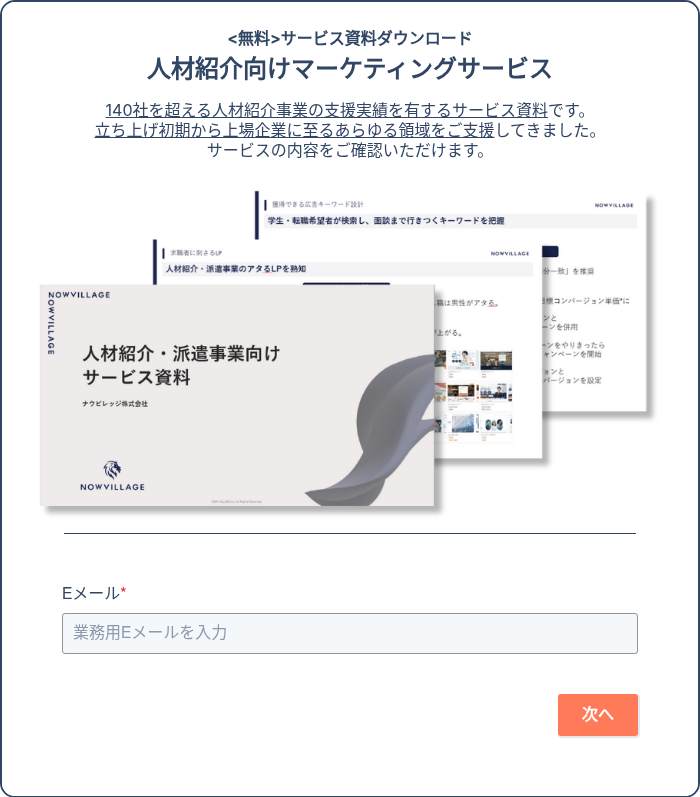
Digital methods for attracting candidates successfully are collected below.
Download here click here。
[Service overview] Marketing support for recruitment agencies
We have also written the B2B version of this guide, on winning vacancies. Do take a look.
SupervisorReviewed by

KUNIYUKI IMAMURAPresident & CEO, NowVillage Inc.
Leads B2B marketing support, covering consulting, advertising operations and web production. Builds teams that can keep delivering results after we hand the work over.
View profileContact
Shall we design your next move in marketing, working back from the result?
Drawing on work with more than 500 companies, we will propose the move that will do the most for you.


